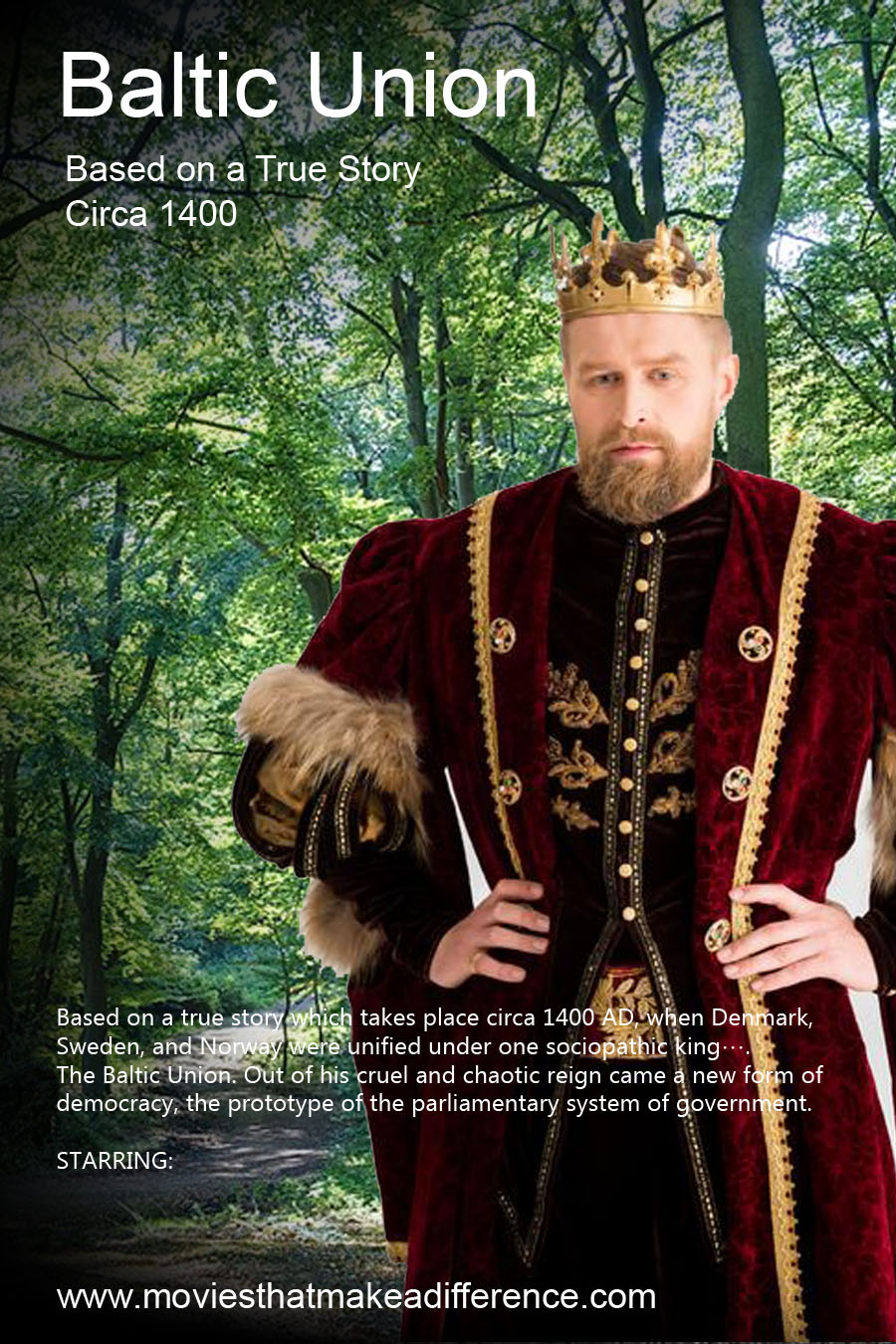
The Baltic Union King of Denmark, Sweden and Norway, King Erik, circa 1400 AD, a sociopath, causes a revolution in Sweden. The Union dethrone Erik, who starts life as a pirate. After the revolution, the Swedes create their own government, Riksdag (Rick´s day meaning Citizen's day), the first democracy of its kind in Europe, a prototype of parliamentary systems of government, used around the world.
Based on a true story circa 1400 AD in Denmark. Danish Princess Margaret marries the King of Norway, Haakon. Their son, Olaf, heir to the crowns of Denmark, Sweden, and Norway, sets the stage for the Baltic Union. Margaret assumes the role of Regent, until Olaf becomes an adult.
Olaf dies unexpectantly. Margaret must replace Olaf with the next male heir, 13-year-old Bagislav of Pomerania. Queen Margaret, the Regent of the proto-Baltic Union changes Bagislav’s name to Erik and the Queen adopts him.
Margaret has her Union intact with Erik as the eventual King of the Baltic Union. Margaret dies unexpectantly aboard the Danish Flag Ship.
Erik now the sole ruler makes some fatal errors during his reign. Erik assigns Danes to oversee tax collection (Bailiffs) and Danish Bishops to Sweden. The cruelty of the bishops and the tax collectors shocks the Swedes.
The Bailiffs collect taxes, in this instance, they burn a village, and kill 5 people by smoking them to death. Englebrekt Englebrektsson, a miner, sees the commotion and runs down to find out what happened. He’s told it was done by the King’s Bailiffs.
Englebrekt goes to the Swedish Council of Nobles only to find the entire government has broken down due to King Erik’s inaction. Englebrekt goes to speak with King Erik about the bailiffs killing Swedish citizens for the Crown’s taxes.
King Erik waves him away with no concern and no change in policy. Englebrekt is pissed. He returns to Sweden and starts a peasant revolt. The peasant revolt exiles or kills the Danish bailiffs. Sweden seceeds from the Baltic Union.
Sweden forms its own government. Englebrekt creates a new form of democracy, Riksdag (Citizen's Day), which includes: the Nobles, Clergy, Merchants, and Peasants. With the goal to maintain the Union, one noble kills Englebrekt.
The peasants revolt again. Their leader captured and beheaded by the murderer of Englebrekt. At first, King Erik, happy about Englebrekt’s death, soon realizes the the Union of all three Kingdoms are quite upset with his rule and dethrone him. Knowing of the dethroning, King Erik throws off his crown and becomes a pirate for 10 years.
The Riksdag holds on by a thread as the Union for the Union take over the government. The peasants and merchants want Citizen's Day. Newly elected Regent Sten Sture again takes up the mantel of Citizen's Day with his full support. This action angers the Union King, King Christian, who wants to bring Sweden back into the Union by force.
King Christian’s troops are ambushed, by the Swedish troops, and the entire Danish army killed. After capture, King Christian spends the rest of his life in a Swedish prison, which destroys the Baltic Union.
THE BALTIC UNION, is a musical, like ‘The Sound of Music’. Queen Margaret, King Erik and Englebrekt Englebrektsson are all gay characters. This is history as seen through the eyes of a gay man without the need to explain away their actual sexuality. The lesson we learn from ‘The Baltic Union’ is that out of a sociopathic rule came a new form of democracy.
A lesson for our day.